

Ancient Attic Greek Black-Figure Lekythos
This lekythos is a tall vessel with a single handle attached to the broad shoulder terminating in a narrow neck and a rather large, semi-spherical mouth covered in black. The lower part of the body and a circular foot are also painted in black. The neck received a delicate decoration of tendrils of ivy with typical heard-shape leaves and stylized berries; it is separated from the shoulder by a band of tongues. The shoulder has a chain of seven, prominently painted palmettes.
Ancient Corinthian Greek Terracotta Lekanis with Panthers, a Sphinx, and Harpies
The lekanis has twin spurred handles on either side of a shallow footed bowl, decorated by three rows of red pomegranates along the rim and a series of red, black, and clay colored bands below
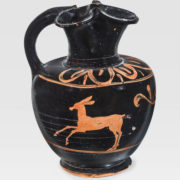
Ancient Apulian Xenon Ware Oinochoe
A trefoil oinochoe with spreading foot and cylindrical handle, The body painted with a deer and an inverted palmette flanked by scrolls, egg-and-dart on the shoulder.
Ancient Corinthian Terracotta Aryballos with Warriors in combat
Attributed to the Warrior Group
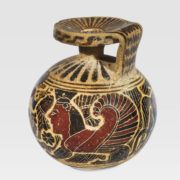
The spherical aryballos depicts two hoplite figures in combat, flanked on one side by a seated sphinx and a horseman on the other. Rosettes and amorphous shapes decorate the remaining planes, with many details painted in red throughout. Tongues adorn the top of the rim and shoulder, zig-zags band along the handle, and a whirl with recessed center features on the underside.
Stela representing a Woman
The stele is like a large, almost rectangular slab. It depicts the bust of a woman with a somewhat stiff and impersonal expression, carved in very high relief. The base, the back and the sides are flat and roughly hewn: it is possible that it served as a funerary stele.
« Token » with Flower Pattern
The ‘token’ (the term is chosen solely because of its shape, with no reference to its ancient use, which is currently unknown) is carved from a small lapis lazuli pebble of a beautiful azure blue, veined with grey in places.
Guttus with Spout and Strainer
A small drinking vessel known as a ‘guttus’. It is a small container designed to fill other vessels, such as oil lamps, via its spout located on the body (which is slender and tapered on the vase in question). As its name suggests, the liquid flowed from it only in small quantities or drop by drop.The shape, size and technique thus allow us to date the production of this vase to Magna Graecia, during the first half of the 4th century BC.
Terracotta Canaanite lamp
The lamp was shaped simply by folding up the rim of a circular plate – which had previously been turned on a potter’s wheel (the traces of the turning are clearly visible, especially on the rim) – at four evenly spaced points: viewed from above, the lamp thus displays an attractive design reminiscent of a four-petalled flower. The wide, round base provides the lamp with optimum stability, meaning it is unlikely to be knocked over.
Cup with a pastoral scene
This cup is impressive, particularly because of the thickness of its walls and its weight. The vessel, made of copper cast in a mould, has no handles: its profile is truncated conical and very linear. It rests on a small, solid triangular foot.
The decoration, in very shallow relief, covers the entire available surface. Three bulls, recognisable by the shape of their horns, stand facing to the right of the viewer.
©Designed by Webgenève - Création de site internet

Rue Etienne Dumont, 9 1204 Geneva
Tel. +4122 301 9378
Email: contact@young-collectors.com